
Nutrition Desk: 5 Reasons the Capsule Handful Isn't Working
Still organizing a tray of memory capsules every Sunday? Meet the $46.01 mango syrup with citicoline, phosphatidylserine and B vitamins — one spoon instead of six more capsules.

The people in this kitchen story are composites, and the author writes for our research desk under a pen name. Every product detail, price and policy below was read from the seller's listing in November 2026.
There is a sound a Sunday organizer tray makes when it snaps shut.
Fourteen little doors. A week of swallowing, planned in advance.
Mine lives on the second shelf, between the honey and the reading glasses I keep forgetting I own.
Every Sunday night I fill it. Every Monday morning I start the clock on the next filling.
Six capsules a morning. A multivitamin, two "memory complex" capsules I bought from a commercial, a fish oil so large it deserves its own zip code, and assorted stragglers the bottle labels call "support."
I am 63, I keep the books for my brother's hardware store, and I can reconcile an invoice column in my head.
But ask me where I set the coffee scoop, and we will both be standing in the kitchen a while.
So when my sister-in-law left a small amber bottle on my counter after Thanksgiving — a syrup, of all things — I did what I always do with anything new.
I read the label before I touched the spoon.
The bottle said Orzax Ocean Cogniven. A mango-flavored syrup, five milliliters a day, sold by Beauty Care Bag for $46.01.
Citicoline, phosphatidylserine, uridine monophosphate, and four B vitamins — in a spoon.
A spoon. Not six capsules.
I laughed at it first. Then I looked at my Sunday tray, and the laugh got quieter.
Maybe the problem was never what I was taking. Maybe it was the pile of it.
5 Reasons I Stopped Adding Capsules to the Tray
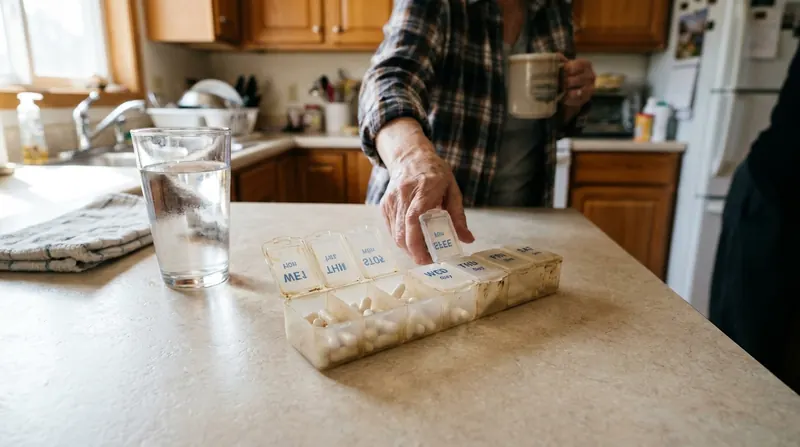
To be clear before we start: capsules are not the enemy.
Some of what I take is there for good reasons my clinician and I discussed.
These five problems are about the pile — the habit of answering every worry with one more bottle.
They are not a finding that all capsule takers should switch to this product.
Read them with your own shelf in mind. Which one sounds most like your kitchen?
1. A Handful Is a Quantity — Not a Plan
More bottles can feel like more effort toward your goals.
Six capsules, eight capsules — the number becomes the reassurance.
But a pile is not a program.
Nobody planned my tray. It accumulated. One bottle for this, two more for that, a free sample that never left.
When I counted mine — six a day, forty-two a week — the arithmetic startled me more than any label ever had.
The syrup bottle, by contrast, prints its whole story on one panel.
150 mg of citicoline, 75 mg of phosphatidylserine, 50 mg of uridine monophosphate, and B vitamins — per 5 ml spoon.
One measured spoon. One label. One thing to remember before the kettle boils.
That is no sleight of hand. It is just countable.
2. Six Labels Means Nobody Reads Any of Them
Be honest: when did you last read a Supplement Facts panel on your own shelf — past the first line?
With a tray of six, reading every label every refill is nobody's realistic evening.
So most of us do what I did: trust the front of the box, swallow, repeat.
With one bottle, the label is short enough that I read it every time I reorder — and I caught something worth catching.
The seller's long description says 250 mg of citicoline per serving.
The Details panel of the same listing says 150 mg per 5 ml.
I wrote to the store before writing this page, and I will tell you exactly what the panels print rather than pick the flattering number.
A six-bottle tray makes that kind of checking impossible. One bottle makes it a five-minute habit.
3. Swallowing Is Its Own Chore — and It Adds Up
There is a reason "horse capsules" deserves to be a phrase.
By capsule four, I was taking them with the enthusiasm of a cat taking a bath.
And here is the part nobody puts on a coupon: a routine you dread is a routine you skip.
I missed my fish oil constantly. Not because I forgot — because I was tired of swallowing.
The listing describes it as a mango-flavored liquid for adults and children 11 and up — which tells you the swallowing bar is set low on purpose.
I am not claiming a spoon is why anyone's Tuesday improves.
I am saying that after decades of capsules, a spoon I do not have to talk myself into is a small mercy I did not expect to matter.
The best supplement routine is the one you actually keep.
4. "Memory Complex" Front Labels Are Doing a Lot of Quiet Work
Pull any capsule bottle sold for "memory support" and look at the dose sizes.
The interesting ingredients are often there in amounts worth asking about.
I am not picking on capsules specifically.
I am picking on vagueness, wherever it lives. My "memory complex" capsules never told me what a serving of their hero ingredient weighed.
The syrup prints milligrams on its panel, so we can put real numbers beside real research — which is the only honest way to shop.
See what just happened?
A real trial, a real dose, and a label that can be compared against both.
That comparison is exactly what a front label reading "memory complex" never lets you make.
I would rather see 150 mg printed and know where it stands than see a proprietary blend and stand nowhere.
5. The Tray Grows Because Every Worry Gets Its Own Bottle
The final problem is structural: a bottle per concern is how the shelf became a shelf.
Memory capsule. Energy capsule. Eye capsule. Joint capsule. Each one plausible. Together, a pharmacy.
The syrup takes a different shape: one spoon carrying four ingredients that researchers have studied individually — citicoline, phosphatidylserine, uridine monophosphate, and a B-complex.
Is that better? Not automatically.
But it changed my question from "which bottle next?" to "does this one spoon cover what I actually care about?"
Two citicoline trials, printed with their sizes, durations, funding caveats and dose gaps.
That is more scrutiny than my capsule tray ever received from me.
If a spoon cannot survive that scrutiny, it does not belong on my counter.
This one stayed. Here is what is actually in it.
Introducing... Orzax Ocean Cogniven Syrup
Orzax Ocean Cogniven is a mango-flavored dietary supplement syrup from the Turkish supplement house Orzax, sold in the US by Beauty Care Bag.
The format is the whole pitch: 150 ml per bottle, a 5 ml spoon once a day, 30 mornings per bottle.
The listed price is $46.01 per bottle (marked down from $54.13 on the listing I read).
Each spoon carries citicoline 150 mg, phosphatidylserine 75 mg, uridine monophosphate 50 mg, and vitamins B1, B2, B6 and B12.
The listing describes it for adults and children 11 and up — this page is written for the grown-ups at the kitchen table.
- - One 5 ml spoon a day — mango-flavored liquid, no capsules to swallow.
- - Citicoline 150 mg · phosphatidylserine 75 mg · uridine monophosphate 50 mg per serving.
- - B vitamins: B1 1.1 mg · B2 1.4 mg · B6 1.4 mg · B12 25 mcg.
- - 150 ml bottle — thirty 5 ml mornings.
- - $46.01 listed price; 30-day returns; free US shipping on orders over $50.
- - Sold by Beauty Care Bag (ARBITBOX LLC), Dover, Delaware — phone and email published.
What made me actually try it was smaller than any of that: the label fits on one panel, and I could read it standing up.
The syrup is designed to fit an ordinary breakfast — one spoon alongside the coffee and the crossword.*
*Individual results vary. No finished-product cognitive benefit has been established for Orzax Ocean Cogniven Syrup.
What the Ingredients Actually Are — Without the Jargon
You don't need a pharmacology degree to follow this.
Each ingredient is one plain sentence, and one honest card where research exists.
Citicoline — the one with the strongest paper trail
Citicoline is a compound the body makes and uses as a building block, and it is the most studied name on this label.
The two trials above tested it at 250-500 mg a day in adults.
The syrup's spoon carries 150 mg.
Below the studied range — printed here because you deserve the real number, not the marketing one.
Phosphatidylserine — the membrane ingredient
Phosphatidylserine is a fat that sits in cell membranes, and the listing leans on it for "structure and function."
The honest research picture is mixed:
A null main result, printed on a selling page.
That is the standard this desk holds itself to — take it as a mark of the page, not a knock on the ingredient.
Uridine monophosphate — the quiet third
Uridine is involved in synthesizing cell membranes; the listing says so and stops there.
So do we: the human trial evidence for uridine alone is thin, and no dose card is offered here for a reason.
The B vitamins — the sensible base
B1, B2, B6 and B12 at or near their Daily Values — the quiet, defensible floor of the formula.
B vitamins have an established role in normal energy-yielding metabolism and nervous system function.
The honest ceiling: a large Cochrane review found B-vitamin supplements made little or no difference to overall thinking scores in cognitively healthy adults. [4]
No jargon survived this section. Neither did the hype.
Can You Picture Yourself This Time Next Month...?

Picture the Sunday night.
No tray to fill. Fourteen little doors, retired to the junk drawer where oddly satisfying things go to live.
The amber bottle comes out of the cabinet once. One spoon. The kettle is already working.
You read the panel while the coffee steeps — all of it, because it is one panel.
Your morning list in your head, the same as always.
But the shelf... the shelf is quieter now.
Maybe you keep one capsule your clinician actually recommended. Good.
The point was never purity. The point was a shelf you can explain.
Thirty mornings per bottle. Then a decision you make with the label in front of you, not with a handful and a shrug.
The Arithmetic on the Counter
The listing I read sells the bottle at $46.01, regular price marked at $54.13 — which works out to about $1.53 per morning for a 30-spoon bottle.
Against my capsule tray — six bottles refilling at various prices, easily $60+ a month — the syrup was, to my genuine surprise, the cheaper shelf.
The store also sells multi-bottle packs: two bottles at 19% off per bottle, three at 25%, ten at 28%.
Free US shipping starts at $50 — so the second bottle rides free.
There is a subscription option that takes another 15% off, adjustable or cancellable.
My rule after a month of spoons: wear out the first bottle before you marry the subscription.
And the 30-day return window stands behind all of it — unopened bottles in original packaging, with damaged or wrong items handled free if you report within 24 hours of delivery.
If your kitchen says no, the counter says no, and that is the whole negotiation.
One dollar fifty-three a morning for a shelf that fits in one hand.
Before You Choose... A Few Straight Answers
Questions readers actually asked
No. It is a mango-flavored liquid syrup — one 5 ml spoon a day, straight or stirred into juice or a smoothie. The bottle holds 150 ml, about thirty mornings.
Citicoline 150 mg, phosphatidylserine 75 mg, uridine monophosphate 50 mg, vitamin B1 1.1 mg, B2 1.4 mg, B6 1.4 mg and B12 25 mcg — the amounts printed on the seller's Details panel.
The seller's long description says 250 mg; the Details panel of the same listing says 150 mg per 5 ml. This page prints the panel's number and flags the mismatch, rather than choosing the flattering one.
No. The study cards describe trials of citicoline and phosphatidylserine as isolated ingredients, at doses above what a spoon of this syrup carries. No finished-product study of Ocean Cogniven is cited here.
The listing describes a mango flavor. This desk found it pleasant over juice; your own spoon is the only review that counts.
The listing describes use by adults and children 11 and older, 5 to 10 ml daily. This page is written for adults; anyone taking anything daily or managing a condition should ask their own clinician first.
The seller accepts returns within 30 days of delivery on unopened, unused bottles in original packaging. Wrong or damaged items are handled free if reported within 24 hours. Refunds process within about 7 business days.
US orders under $50 pay $9.99; $50 and above ship free. A single bottle is $46.01, so the second bottle in the popular pack clears the free-shipping line.
Beauty Care Bag, operated by ARBITBOX LLC, 8 The Green Ste A, Dover, DE 19901. Phone +1 (812) 750-1104, email info@beautycarebag.com, Mon-Fri 9 AM to 6 PM Central.
The current listing carries the Details panel and the seller's description. The ingredient and advertising guide linked in our page footer explains each line of this bottle and grades our own headlines.
What I Would Tell You Across the Kitchen Table
Before you go to the listing, bring the decision back to the shelf you actually have.
You don't need six bottles to show you care about staying sharp.
You never did.
You don't need to swallow anything you dread to keep a promise to yourself.
And you don't need to choose between honest numbers and a routine you can keep.
This bottle prints both.
The Sunday organizer is in the junk drawer now.
The spoon is in the sugar bowl, which is where spoons have always lived.
Put the label beside the price, the way I did. Then decide what belongs on your counter.
$46.01 listed · 30-day returns · Free US shipping over $50 · Label and full details on the seller's page
P.S. Still restocking the capsule tray this Sunday? One amber bottle, one mango spoon and one readable label is the alternative — about $1.53 a morning before any pack discount.
P.P.S. The study cards print the dose gap on purpose. If a page hides the numbers, ask why. Ours is in the footer's ingredient guide.
Sources and Product Information
Ingredient research: Nakazaki et al., The Journal of Nutrition, 2021, DOI 10.1093/jn/nxab119; McGlade et al., Food and Nutrition Sciences, 2012, DOI 10.4236/fns.2012.36103; Kato-Kataoka et al., Journal of Clinical Biochemistry and Nutrition, 2010, DOI 10.3164/jcbn.10-62; Rutjes et al., Cochrane Database of Systematic Reviews, 2018, CD011906. These papers tested isolated ingredients, not the featured syrup.
Product and policy source: the seller's listing and store policies at beautycarebag.com, read November 7, 2026 — product Details panel, subscription and pack pricing, shipping rates, and the 30-day returns policy. Seller pages can change; review current terms before ordering.
The full label of this bottle — what citicoline, phosphatidylserine, uridine monophosphate and each B vitamin are, what the cited research does and does not say, and which of our advertising headlines deserve your skepticism — is written out in the ingredient and advertising guide linked at the foot of this page.